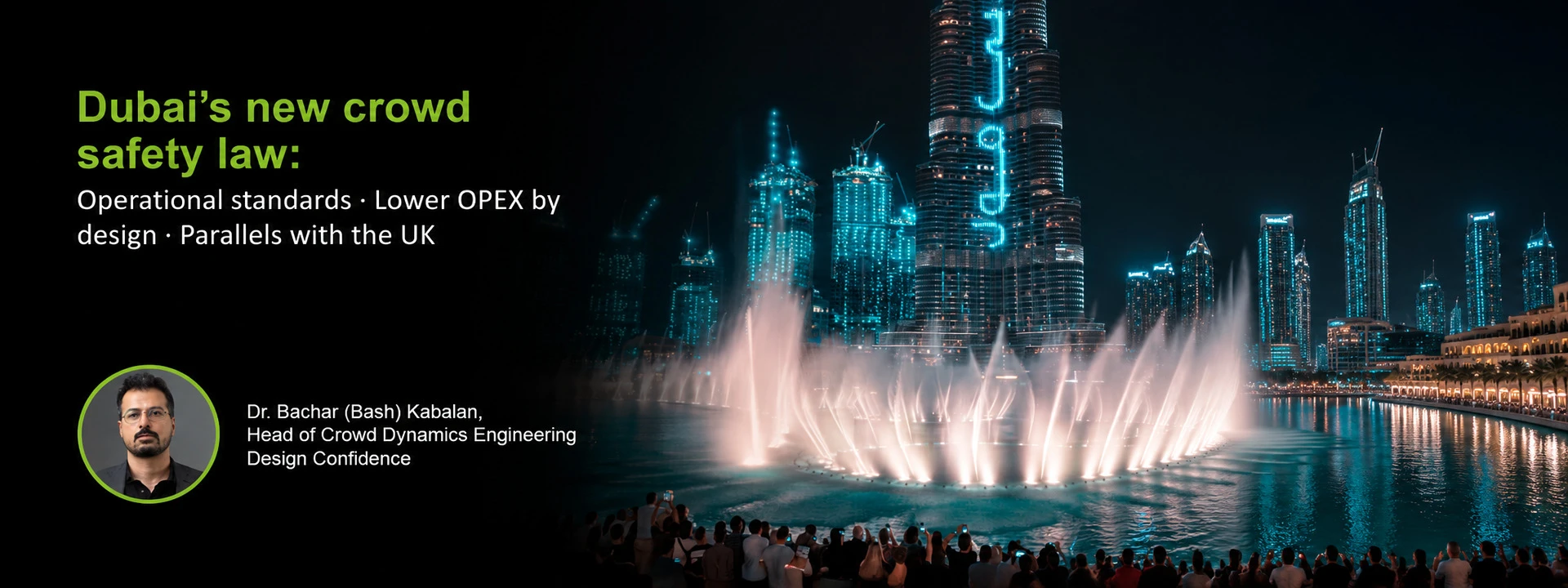
Dubai’s new crowd safety law: Operational standards · Lower OPEX by design · Parallels with the UK
| Crowd Dynamics EngineeringBy Dr. Bachar (Bash) Kabalan, Head of Crowd Dynamics Engineering, Design Confidence
What the law says about crowds?
Sheikh Mohammed bin Rashid Al Maktoum, Ruler of Dubai, has issued Law No. (2) of 2026 on public safety [1]. It sets a clear legal framework to raise safety standards for people and property and to support sustainable development. It took effect on 1 June 2026.
Much of the law targets public venues and events, where large numbers of people gather. Organisers and operators must now meet detailed safety standards to protect visitors. The law covers equipment standards, lighting and ventilation, safe entry and exit, capacity limits to prevent overcrowding, and noise control. Every venue and event must carry fire-fighting equipment, first-aid resources, and emergency alarm systems. Organisers must appoint trained safety supervisors. They must also maintain a public safety management plan. [2]
Enforcement carries real weight. Fines run from Dh500 to Dh1 million, depending on the offence. A repeat violation within a year can double the fine to Dh2 million. Responsibility sits with the venue owner. Dubai Municipality and the relevant authorities are not liable for harm caused by an owner who fails to follow the rules. That liability rests with the owner. [3]
With this law, Dubai sets out to make its venues safer for residents, visitors and businesses, and to strengthen its standing as a secure, world-class city.
What this means for design, planning, operations and training?
The law sets a clear standard for venues and events in operation. On the surface, it targets existing venues. The larger opportunity sits with new ones. Through design, you can deliver the best visitor experience at the lowest operational cost.
Operations-led design lets the operation shape the building. Consider a venue you are building, where visitors will have to cross a road that is also not yet built. That crossing will be problematic, for road traffic and for visitors. In design, there is a chance to move the road, change the location of the car park, or plan a traffic diversion, so the walk from car park to venue is calm and direct. That has a significant impact on visitor experience, and a large impact on operational cost. You need far fewer barriers, far fewer staff, and you remove any effect on road traffic. The gains are large, and the cost during design is next to nothing.
For existing venues, the focus shifts to planning and operations. By writing these requirements into law, Dubai compels venue operators and event planners to treat crowd management as a formal discipline. Crowd planning, across most of the world, is not an established profession. Many practitioners work from experience gained on the job. That experience is valuable, however it is not easily transferable and leaves gaps.
Crowd dynamics is a science. We understand why crowd incidents happen.
They almost always trace back to identifiable failures in design, information or management. Standard methods and tools exist to find these risks during planning and resolve them before an event opens. Rigorous planning should allow us to identify and mitigate all foreseeable risks.
The law already requires trained safety supervisors and a public safety management plan. Meeting that well calls for dedicated, structured knowledge, so the law pushes owners and operators toward professional expertise. Training programs exist to build it. Their value rests on one idea: crowds can be managed when they are understood. Treated as a science, crowd dynamics provides that understanding. Known methods and techniques, grounded in evidence and tested in practice, govern the movement, behavior and safety of large numbers of people. Safer venues and events in Dubai depend on the right laws and the right designs. They depend just as much on people at every level trained to apply this knowledge with confidence and rigor.
The bigger picture: advancing crowd safety knowledge in the UAE.
Law No. (2) of 2026 is a major step. Its full value will show as the technical and professional capacity to deliver it grows alongside it. That is where the UAE's opportunity sits.
The United Kingdom's experience is an encouraging parallel. Its framework took shape in the early 1970s [6]. The first Guide to Safety at Sports Grounds, the Green Guide, appeared in 1973 [5], followed by the Safety of Sports Grounds Act 1975, which introduced safety certificates for designated grounds [4]. The guidance came first. The Act then gave much of it legal force. Over the decades that followed, the Green Guide grew into a body of knowledge, standard methods, certified training and a community of practitioners who treat crowd safety as a technical discipline. Today the UK framework is regarded worldwide as a benchmark. Dubai is well placed to reach that same depth of expertise, and to build it from a position of foresight.
Dubai’s Law No. (2) of 2026 can set a similar process in motion. Where many frameworks around the world took shape slowly, across decades of incremental change, Dubai is building its own early and by design, as a matter of foresight.
This fits the wider vision of Dubai’s leadership: a city that anticipates risk, legislates ahead of demand, and builds the capability to match. Its stated aim to align with international best practice reflects a leadership that looks outward and forward at once.
The law is in place, and the standards may follow. They reach both existing venues and those still to be designed and built. For the later, the opportunity to significantly reduce CAPEX through design. Dubai’s Law No. (2) of 2026 can grow crowd safety into a serious, science-based profession across the UAE, built on foresight by people who choose to lead.
References
[1] Dubai Media Office, "Mohammed bin Rashid issues law on public safety," 6 March 2026. mediaoffice.ae — issuer, effect date, venue requirements, penalties and liability.
[2] Gulf Business, "Dubai introduces new public safety law: what you need to know," 2026. gulfbusiness.com — summary of venue and event obligations.
[3] Al Suwaidi & Company, "Dubai introduces a new legal framework for public safety," 2026. alsuwaidi.ae — legal analysis of penalties, compliance period and owner liability.
[4] Safety of Sports Grounds Act 1975, UK. legislation.gov.uk — framework for safety certification at designated sports grounds.
[5] Sports Grounds Safety Authority, "Green Guide (Guide to Safety at Sports Grounds)." sgsa.org.uk — publisher and current edition.
[6] Hillsborough Independent Panel report, "Stadium safety standards in 1989." policeconduct.gov.uk — official chronology: Ibrox 1971, first Green Guide 1973, Safety of Sports Grounds Act 1975.
At Design Confidence, our Crowd Dynamics team supports projects of all scales, from early design and capacity planning to pedestrian flow analysis, crowd modelling, evacuation studies and operational crowd safety strategies. We work closely with designers, developers and operators to create safer, more efficient and people-focused environments. If you are working on a project where crowd movement, safety or capacity is a consideration, our team would be happy to support.
Get in touch: bids@designconfidence.com