Fire and Life Safety in the Middle East’s Expanding Rail Network
| Fire Life Safety Engineering ConsultancyBy Anam Asad, Executive Partner, Design Confidence
The Middle East is developing some of the most ambitious transport infrastructure projects in the world.
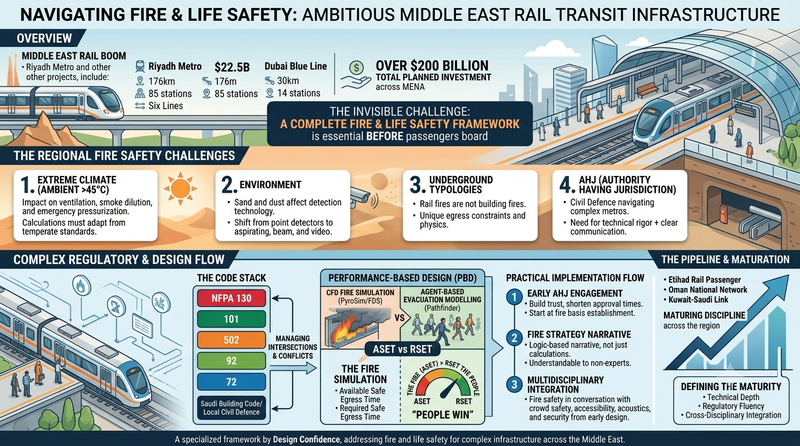
The Riyadh Metro represents the scale of this investment. The network was developed at a cost of approximately USD 22.5 billion and includes 176 kilometres of railway, 85 stations and six lines. It opened in December 2024 as the world’s longest fully automated driverless metro network and carried approximately 1.9 million passengers during its first week of operation.
Dubai’s Blue Line is currently under construction, with an estimated investment of USD 15 billion. The project will include approximately 30 kilometres of track and 14 stations. Etihad Rail is also progressing towards the commencement of passenger services across the UAE.
Oman, Bahrain, Kuwait and Qatar have railway programmes at different stages of planning and development. The total planned investment in rail infrastructure across the Middle East and North Africa is estimated to exceed USD 200 billion.
However, one important part of these projects rarely receives public attention.
Before passengers can enter a station, board a train or use an escalator, a complete fire and life safety framework must be designed, assessed and approved. More importantly, the strategy must perform effectively during a real emergency.
The challenge isn’t one thing. It’s everything at once
The fire and life safety challenges associated with underground rail systems cannot be addressed in isolation. A fire within an underground railway environment is different from a fire within a conventional building. The fire behaviour is different. The movement of smoke is different. The evacuation constraints are different. The operational response is also different.
The regulatory environment introduces further complexity. International standards provide an important technical basis, but they must be interpreted together with local codes, Civil Defence requirements and project specific conditions.
The Middle Eastern climate adds another important design consideration. Ambient temperatures can exceed 45 degrees Celsius during the summer. These conditions affect ventilation calculations, smoke control systems and emergency pressurisation systems. Fresh air introduced for smoke dilution may already be at a high temperature. CFD models developed using default temperate climate conditions may therefore produce unrealistic or non conservative results. The local environmental conditions must be properly included within the design assumptions and simulation inputs.
Sand and dust also influence the selection of fire detection systems. Conventional point type smoke detectors that perform effectively in cities such as London or Sydney may not provide the same level of reliability in Dubai or Riyadh.
As a result, aspirating smoke detection systems, beam detectors and video based fire detection technologies are becoming increasingly common within major transport projects.
The approval process is part of the design
The relationship with the Authority Having Jurisdiction is also a critical part of the design process. In several jurisdictions, Civil Defence authorities are reviewing complex underground metro systems and transport interchanges that are relatively new to the region. A technically correct fire strategy is not sufficient if the reviewing authority cannot clearly understand the design intent, assumptions and supporting evidence. The fire strategy must therefore be technically rigorous, clearly structured and easy to follow. The approval process should not depend on the authority accepting complex engineering conclusions without sufficient explanation.
The Code Framework
Most major rail projects in the Gulf are designed using a combination of international standards and local regulatory requirements.
NFPA 130 is commonly adopted as the primary standard for stations, platforms, concourses and railway tunnels.
NFPA 101 may be used to support the design of ancillary occupancies and associated building areas.
NFPA 502 provides requirements and guidance relating to road tunnel and underground infrastructure fire safety.
NFPA 92 establishes the basis for smoke control system design.
NFPA 72 addresses fire detection, alarm and emergency communication systems.
In Saudi Arabia, the Saudi Building Code and Civil Defence requirements must also be applied in parallel with the relevant international standards. Whereas in UAE, the UAE Fire and Life Safety code of practive has to be complied with. The main challenge is not simply identifying the applicable codes. The challenge is managing the relationship between them. There may be areas where requirements overlap, conflict or remain silent. In such cases, the fire engineer must establish a clear and technically justified design position. Where full prescriptive compliance is not practical, a performance based solution may be required. This solution must be supported by engineering analysis rather than relying only on code precedent.
What I See in Practice
The organisations that manage these projects successfully engage with the authority at an early stage. This engagement should begin while the fire safety design basis is being developed and while departures from prescriptive requirements are still being identified.
Early engagement provides the authority with an opportunity to understand the proposed design approach before major design decisions are finalised. When this process is managed properly, it can reduce approval delays, avoid late redesign and build trust between the design team and the reviewing authority.
The strongest fire strategies are written as clear engineering narratives, not simply as a collection of calculations. The document should explain the hazard, the design response and the evidence used to verify the outcome. An authority reviewer should be able to follow the complete design logic without needing specialist knowledge of every modelling tool or calculation method.
Integration Between Disciplines
Fire and life safety cannot be developed independently on a major transport project. A large station or transport interchange must consider fire safety, crowd movement, accessibility, security, building services and operational requirements together.
A decision affecting one discipline may directly affect another. For example, changes to station capacity may influence evacuation time, exit width, smoke control requirements, accessibility provisions and security operations.
The most successful projects bring these disciplines together from the earliest design stages. This level of coordination allows risks to be identified earlier, improves design efficiency and creates a safer and more practical final outcome.
The Middle East is building transport infrastructure at an extraordinary scale. The success of these projects will not only be measured by their length, capacity or construction value. It will also be measured by how safely they operate and how effectively they protect passengers during an emergency.
What’s coming
The pipeline doesn’t slow down. Etihad Rail passenger service. Oman’s national network. The Kuwait-Saudi cross-border link. The Development Road rail corridor from Iraq to Turkey. Each will carry fire safety design requirements shaped by NFPA frameworks, local authority interpretation, and the particular performance demands of extreme climate, complex geometry, and massive passenger throughput. The discipline is maturing rapidly across the region. The firms and engineers who can combine technical depth with regulatory fluency and cross-disciplinary integration will define what that maturity looks like.
At Design Confidence, fire and life safety is one of seven disciplines we bring to complex infrastructure projects across the Middle East and India. If you’re working on a rail or infrastructure project in the region and want to talk through the fire safety design framework, I’d welcome the conversation.