SAHEL Rating System Certification Levels: Accessible, Adaptable, Inclusive and Exemplar
| Accessibility ConsultancyBy Dania Al-Adhami, Head of Accessibility and Inclusivity, Design Confidence
The SAHEL Rating System has changed how accessibility is measured in Abu Dhabi. Launched by the Department of Municipalities and Transport (DMT) in 2025, and named after the Arabic word for ease, SAHEL turns accessibility from a compliance checklist into a rated outcome. Every new masterplan, public space and building is now assessed and certified at one of four levels: Accessible, Adaptable, Inclusive or Exemplar. For developers, architects and asset owners, understanding these SAHEL Rating System certification levels is the first step to planning a project that performs well, secures permits smoothly and genuinely serves the people who use it.
This guide explains what each SAHEL level means, how points translate into a rating, which roles influence the score, and how to choose the right target for your project. It is written from the perspective of an Accessibility Consultant in Abu Dhabi that works with SAHEL every day.
Key Takeaways
- The SAHEL Rating System is mandatory for new developments in Abu Dhabi and covers communities, public realm and buildings.
- Projects are certified at four levels: Accessible, Adaptable, Inclusive and Exemplar.
- Mandatory credits must always be met; optional credits earn points that determine the final level.
- Appointing a SAHEL Qualified Professional (SQP) is mandatory, and appointing an Accessibility Consultant early earns valuable credits.
- The earlier the target level is set, the easier and cheaper it is to achieve.
What is the SAHEL Rating System?
SAHEL is Abu Dhabi's accessibility rating system for the built environment. Following a one-year pilot, it became mandatory for new developments and is planned to extend to existing buildings and spaces over time. It aligns with Abu Dhabi's long-standing commitment to people of determination and with the wider ambition to make the emirate one of the most liveable places in the world.
Unlike a traditional code, which simply sets a minimum, SAHEL rewards projects that go further. It recognises that accessibility is a spectrum. A building can meet every minimum dimension and still be confusing, tiring or stressful to use. SAHEL's levels give the industry a shared language for describing how well a place really works for people of all ages and abilities.
The three SAHEL assessment categories
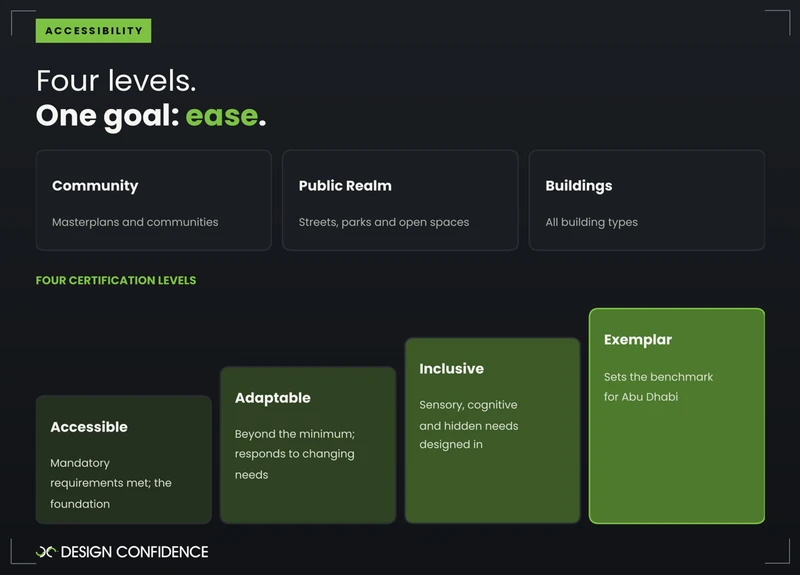
The SAHEL Rating System is organised into three categories, each with its own handbook and credits:
- SAHEL Community Rating for communities and master-planned developments, assessed at Concept Master Plan (CMP) and Detailed Master Plan (DMP) stages.
- SAHEL Public Realm Rating for streets, parks, plazas, waterfronts and other open spaces.
- SAHEL Building Rating for buildings of all types, from residential towers and schools to malls, hospitals and cultural venues.
Many large projects involve more than one category. A new district may need a Community rating for the masterplan, Public Realm ratings for its parks and streets, and Building ratings for individual plots. Coordinating these from the start avoids gaps at the boundaries, where accessible routes often break down.
The four SAHEL certification levels explained
Accessible is the foundation. A project at this level meets all mandatory requirements of its handbook, so people can arrive, enter, move around and use facilities independently. It covers the essentials: step-free routes, accessible entrances, appropriate circulation widths, accessible toilets and parking, and suitable signage. Accessible should be seen as the floor rather than the ceiling, and for most public-facing projects it is the starting point rather than the end goal.
Adaptable recognises projects that go beyond the minimum and can respond to people's changing needs over time. This often includes flexible housing layouts that can be adapted as residents age, future-proofed vertical circulation, structural provision for later adaptations, and a well-developed Accessibility Strategy. Adaptable is a strong target for residential communities and mixed-use developments, where the same homes and spaces must serve families across decades.
Inclusive reflects a broader understanding of users. In addition to physical access, Inclusive projects address sensory, cognitive and hidden disabilities, older adults, children and carers. Typical features include quiet spaces, intuitive wayfinding, good acoustics, hearing enhancement systems, Changing Places facilities and generous rest points. Inclusive is often the right target for transport hubs, healthcare, education and major public buildings.
Exemplar is reserved for projects that set the benchmark for Abu Dhabi accessibility. Here, inclusion shapes the concept, the experience and the operation of a place. Exemplar projects typically involve people with lived experience of disability throughout design, demonstrate innovation and commit to strong operational management. Flagship cultural destinations, landmark public spaces and government buildings are natural candidates.
How credits and points turn into a level
Each SAHEL handbook is structured around credits. Some credits are mandatory and must be satisfied regardless of the target level; failing a mandatory credit means a project cannot be certified. Other credits are optional and earn points. The total points achieved determine whether a project is certified as Accessible, Adaptable, Inclusive or Exemplar.
Many of the highest-value credits depend on decisions made during concept and early design, such as site levels, route networks, building layout, core positions and the mix of uses. Once these are fixed, points become harder and more expensive to secure. This is why early planning has such a strong influence on the final rating.
The role of the SQP and the Accessibility Consultant
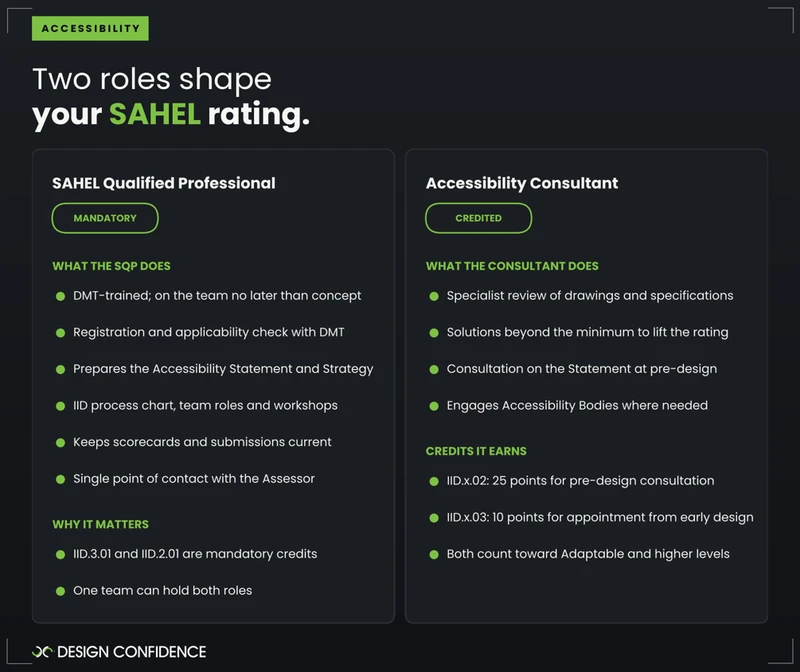
Two project roles have a direct effect on the score. The SAHEL Qualified Professional (SQP) is mandatory. The SQP is DMT-trained, joins the team no later than concept, and is linked to mandatory credits IID.3.01 and IID.2.01. The SQP manages registration and the applicability check, prepares the Accessibility Statement and Strategy, runs the IID process and workshops, keeps scorecards current and acts as the single point of contact with the Assessor.
Appointing an Accessibility Consultant is credited rather than mandatory, but the points are significant. Consultation on the Accessibility Statement at pre-design (IID.x.02) is worth 25 points, and appointment from early design (IID.x.03) adds a further 10. Both count toward Adaptable and higher levels. The handbooks allow one team to hold both roles, which simplifies coordination and keeps accessibility advice consistent from concept to certification.
How to choose the right SAHEL target level
The right target depends on the project's purpose, its users and its ambitions. Consider:
- Who will use the place? Public buildings, healthcare, transport and cultural venues serve the widest range of people and usually justify Inclusive or Exemplar.
- How long will it be used? Homes and communities benefit from Adaptable features that support people as their needs change.
- What is the brand promise? For landmark developments, a higher SAHEL level is a visible signal of quality to buyers, tenants and visitors.
- What is the budget and programme? Setting the target early lets the design team pursue the most cost-effective credits.
Whatever the target, it should be agreed at the start and recorded in the Accessibility Strategy, so every consultant understands which credits are being pursued and why.
Common mistakes that limit a SAHEL rating
- Appointing the SQP late, after key design decisions are fixed.
- Treating SAHEL as a submission exercise rather than a design tool.
- Losing accessible features through value engineering during construction.
- Ignoring the boundaries between plots, public realm and transport, where journeys break down.
Forgetting that accessibility must be maintained in operation and renewed every five years.
Frequently asked questions
Is the SAHEL Rating System mandatory?
Yes. SAHEL is mandatory for new developments in Abu Dhabi, and it is planned to extend to existing buildings and spaces over time.
What is the minimum SAHEL certification level?
The minimum is Accessible, which requires all mandatory credits for the relevant handbook to be met.
Do I need an SQP for my project?
Yes. A SAHEL Qualified Professional must be on the project team no later than concept stage and is linked to mandatory credits.
Can one consultant act as both SQP and Accessibility Consultant?
Yes. The handbooks allow one team to hold both roles, which simplifies coordination and earns credits for early accessibility input.
Work with us: Planning a project in Abu Dhabi? Speak to our SAHEL Qualified Professionals early to set the right target level, secure early-appointment credits and protect your rating from concept to certification.
About Design Confidence
Design Confidence is a leading Accessibility Consultant in Abu Dhabi, providing SAHEL Rating System advisory, SAHEL Qualified Professional (SQP) services, accessibility audits, Universal Design strategies and inclusive design reviews for masterplans, public realm and buildings. Our team includes in-house SAHEL Qualified Professionals and IAAP-certified (CPABE and CPACC) accessibility specialists, and supports developers, architects, engineers and government organisations from registration through to certification and renewal, delivering accessible, compliant and future-ready projects across Abu Dhabi.